
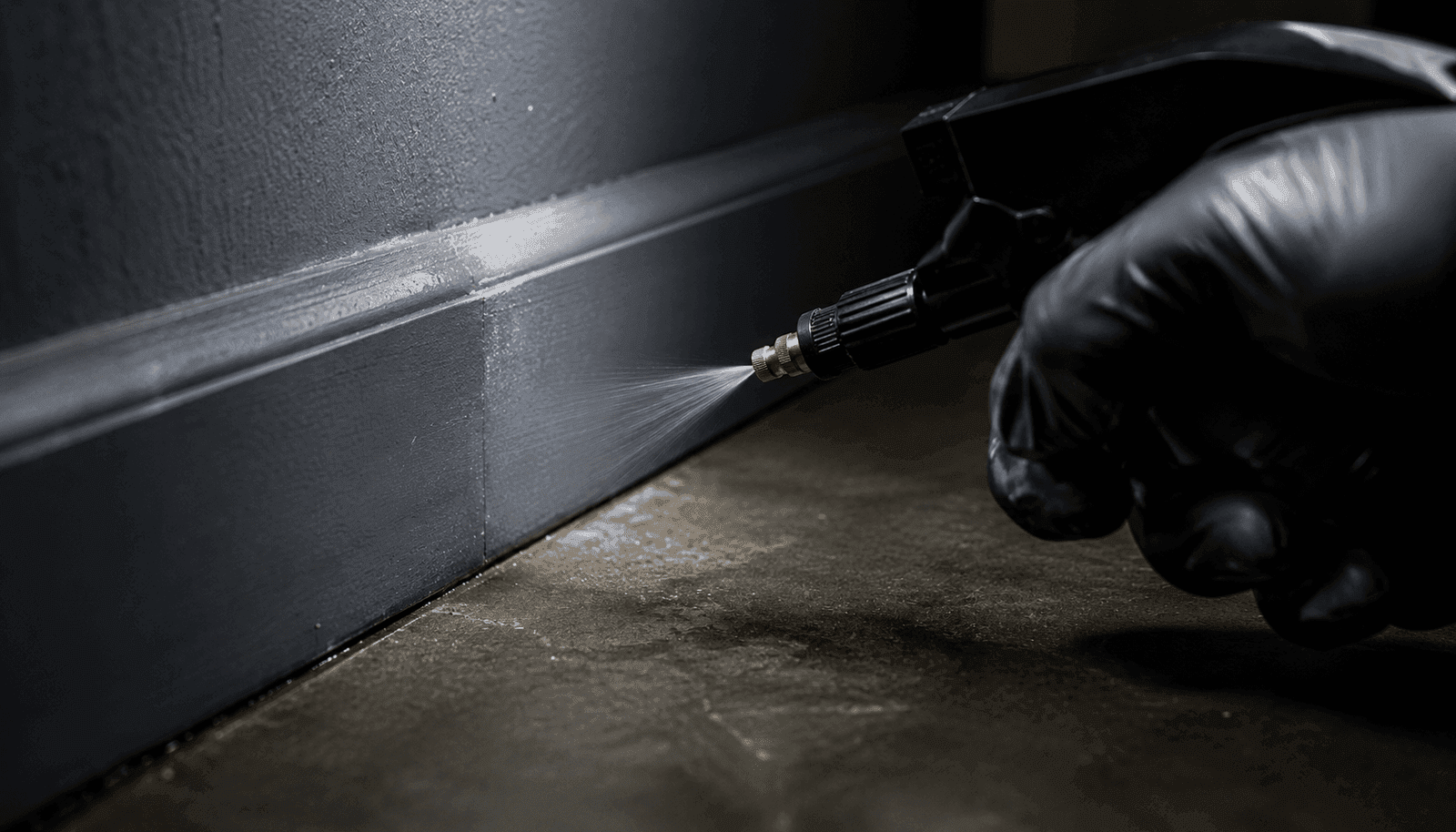
A spray feels decisive. The cockroaches scatter, a few die on the floor, and the kitchen looks solved by evening. Then, two or three weeks later, you switch on the light at midnight and see one crossing the counter again.
That pattern is not bad luck. When cockroaches keep coming back every few weeks, the treatment is addressing the insects you can see rather than the place they are living.
Mumbai flats give cockroaches exactly what they need
Three things drive cockroach pressure in the city, and most flats have all three.
Shared plumbing. A Mumbai building is one connected water system. Cockroaches move along pipe shafts, through gaps around waste lines, and between floors. Treating only your kitchen leaves the route open.
Year-round warmth and moisture. German cockroaches prefer warm, humid harbourage — the inside of a cabinet hinge, the back of a fridge motor, the space behind a washing machine. Mumbai supplies that environment in every month of the year.
Food that is always available. A crumb line under the counter, a bin that is emptied nightly but not washed, pet food left down, water in a drain trap. None of this looks like an infestation. All of it sustains one.
Monsoon adds a fourth factor: drains and seepage. When water tables rise and drainage backs up, American cockroaches move up from the sewer lines into ground-floor kitchens and bathrooms. That is a different insect with a different route, and it needs a different response.
Spray versus gel bait: the difference is reach, not strength
A contact spray is a surface treatment. It leaves a residue on the surfaces you sprayed. A cockroach that walks across it later picks up a dose. That works for the insects moving in the open, which is a small share of the population.
Gel bait is a food-source treatment. It is placed as small points in cracks, hinges, and corners where cockroaches already travel. The insect feeds, returns to the harbourage, and the effect spreads through the group. This is why gel bait can reduce a population that never walks across a sprayed surface.
There is a practical difference too. Sprays push insects deeper into cracks and can split a population across a flat. Bait draws them to a known point. This is the main reason cockroaches keep coming back after a spray-only visit: the harbourage was never touched. For German cockroaches in kitchens, bait is usually the more useful tool; sprays still have a role for crawl spaces, drains, and perimeter work.
Neither approach fixes an open food source. That is why a treatment without proofing tends to fade after a few weeks.
What a proper cockroach treatment actually involves
The sequence matters more than the product.
1. Survey first. A technician should identify the species, find the harbourage, and check the routes between flats — pipe shafts, skirting gaps, drain connections. Treating without this step is guesswork.
2. Bait placement, not broadcasting. Gel goes into cracks and hinges in measured points. It should not be smeared along open surfaces where it can be wiped away or reached by children and pets.
3. Proofing. Gaps around waste pipes get sealed. Loose skirting is addressed. Drain covers are checked. This is the step that decides whether the result lasts a season or a fortnight.
4. Follow-up. Bait activity is reviewed after two to three weeks. If the population has not dropped as expected, the placement was wrong or a second harbourage was missed.
A one-visit treatment with no follow-up is a spray with paperwork.
Where to look before you call anyone
You can often find the source yourself in ten minutes. Check these in order:
- The hinge side of kitchen cabinet doors, especially the cabinet under the sink
- Behind and under the refrigerator, and around the compressor at the back
- The gap where the kitchen platform meets the wall
- Inside the gap around the waste pipe under the sink
- Bathroom drain covers and the floor trap
- Behind the washing machine and any stored cardboard
- The area around the building's garbage chute, if your floor has one
Cardboard is worth calling out. Corrugated boxes give cockroaches both harbourage and a food source, and they arrive with deliveries. Breaking boxes down and removing them the same day removes an entire nursery.
When DIY is enough, and when it is not
Sealing food, fixing a leaking tap, and removing cardboard will reduce pressure in a flat with an occasional stray. That is worth doing regardless of anything else.
Call a professional when you see any of these:
- Repeated sightings within a week, especially in daylight
- Droppings or egg cases in more than one room
- Cockroaches in a flat above or below yours
- A food business, clinic, or society kitchen on the premises
- An infestation that returned after a retail spray or fogger — cockroaches keep coming back because the harbourage is still active, not because the product was weak
For a housing society, the shared lines matter more than any single flat. Treating one kitchen in a building with an active chute or shaft problem rarely holds. Our society pest control programme is built around that shared-infrastructure problem rather than individual units.
What to ask before you book
Four questions separate a survey from a sales visit:
- Which species did you find, and where is it living? A technician who cannot answer this has not surveyed.
- What is being applied, and where? You should get a clear answer, including the placement method.
- What is the follow-up window? Bait work needs a review visit; ask when it happens.
- What do I need to change? Proofing and storage advice should be part of the job, not an optional extra.
If a quote promises a result without a survey, that is a signal about the process, not a bargain.
The bottom line
Cockroaches keep coming back when the harbourage survives. Spray treats the visible surface, bait reaches the nest, and proofing closes the route back in. Do all three and the result holds; skip one and you will be buying the same treatment again in a month.
If you are in Mumbai and want the source identified rather than guessed at, book a free inspection. We survey the flat, name the species, and tell you what the job actually needs. For kitchens where chemical sensitivity is a concern, the herbal and low-toxicity route is also available.
For the full scope of what we treat, see cockroach control in Mumbai.